
Home

Main navigation

  • Projects
  • Publications
    • Browse all
    • What We're Reading
  • Events
  • Network
    • Member Organizations
    • Research Advisory Council
  • About Us
    • Updates

Enter the terms you wish to search for.
  • article | 8 February 2024
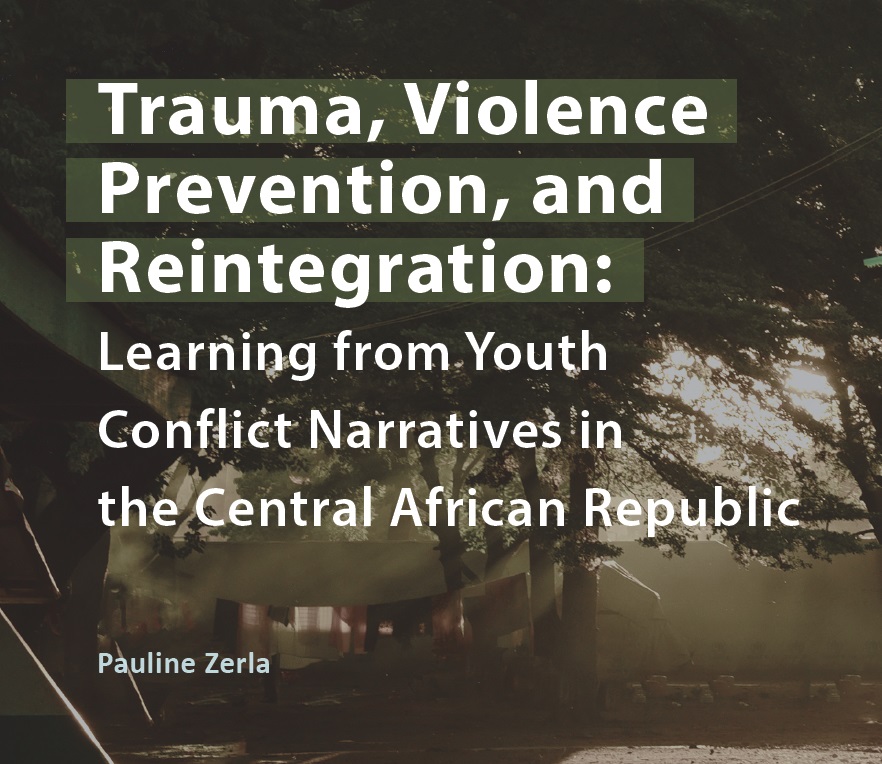
    Trauma, Violence Prevention, and Reintegration: Learning from Youth Conflict Narratives in the Central African Republic
    Edited by: Pauline Zerla
    This research report is a case study on the relationship between trauma, peacebuilding, and reintegration for conflict-affected youth in the Central African Republic (CAR) following the 2019 peace agreement. Based on qualitative research fielded in Spring 2022, the study examines how youth experience conflict, trauma, and reintegration in CAR, highlighting individual experiences through a participant narrative approach. In doing so, the report provides localized insight into the challenges that impact social reintegration and cohesion in fragile, conflict-affected contexts. The report further underscores the implications of these insights for local and international efforts to establish peace and security through disarmament, demobilization, and reintegration (DDR) programs and community violence reduction (CVR) initiatives.In addition to standard data collection methods such as interviews and focus group discussions, data collection undertaken for this report utilized a trauma-informed method called body mapping. The use of body maps—life size images of a human body with visual representations of experiences— in research can offer a means for individuals to reflect on potentially difficult experiences through a non-verbal process. Given the potential relevance of this tool in future studies examining the nexus between conflict, reintegration, mental health, and trauma, this report also includes discussion of the implementation of this method with considerations for others hoping to adapt it for their own use.Suggested citation: Zerla, Pauline. Trauma, Violence Prevention, and Reintegration: Learning from Youth Conflict Narratives in the Central African Republic. Washington, DC: RESOLVE Network, 2023. https://doi.org/10.37805/lpbi2024.1.This publication and research were produced with funding from the U.S. Agency for International Development (USAID)’s Africa Bureau. RESOLVE would like to thank USAID’s Africa Bureau for its generous support for this report and RESOLVE’s Learning from Local Peacebuilding Approaches Research Initiative.The views expressed in this publication are those of the authors. They do not necessarily reflect the views of the RESOLVE Network, acknowledged partners contributing to the production of this publication,the U.S. Institute of Peace, or any entity of the U.S. government.
  • article | 14 December 2023
    Reaching Behind Frontlines: Promoting Exit from al-Shabaab through Communications Campaigns
    Edited by: James Khalil, Yahye Abdi, Andrew Glazzard, Abdullahi Ahmed Nor, and Martine Zeuthen
    This research was conducted in the context of a Somali state offensive in the Federal Member States of Hirshabelle and Galmudug that generated more territorial gains from al-Shabaab than any other military campaign since the mid-2010s. Such conditions provide fertile ground for disengagement from the insurgents, with many ex-members enrolled into the National Program for the Treatment and Handling of Disengaged Combatants. A core element of this program is its communications pillar, which seeks to promote disengagement through a variety of channels, including radio, television, social media, phone conversations, leaflets, and word-of-mouth. This research aims to inform these campaigns, drawing from interviews conducted in May 2023 with former members of al-Shabaab at the Serendi center in Mogadishu.Suggested citation: Khalil, James, Yahye Abdi, Andrew Glazzard, Abdullahi Ahmed Nor, & Martine Zeuthen. Reaching Behind Frontlines: Promoting Exit from al-Shabaab through Communications Campaigns. Washington, DC: RESOLVE Network, 2023. https://doi.org/10.37805/lpbi2023.2.This publication and research were produced with funding from the U.S. Agency for International Development (USAID)’s Africa Bureau. RESOLVE would like to thank USAID’s Africa Bureau for its generous support for this report and RESOLVE’s Learning from Local Peacebuilding Approaches Research Initiative.The views expressed in this publication are those of the authors. They do not necessarily reflect the views of the RESOLVE Network, acknowledged partners contributing to the production of this publication,the U.S. Institute of Peace, or any entity of the U.S. government. Updated: December 18, 2023
  • article | 14 December 2023
    The ‘Off-Ramp’ from al-Shabaab: Disengagement During the Offensive in Somalia
    Edited by: James Khalil, Yahye Abdi, Sif Heide-Ottosen, Abdullahi Ahmed Nor, and Martine Zeuthen
    Al-Shabaab has been evicted – at least temporarily – from scores of towns and villages in the central Somali Federal Member States of Hirshabelle and Galmudug since summer 2022. While this began as an ‘organic’ uprising led by clan militias (the Ma’awisley) against the insurgent’s excessive demands for ‘taxation’ and recruits, it soon transformed into a major state offensive. Within this context, in May 2023 our team conducted interviews with former members of al-Shabaab who had been based in these locations to explore how and why they left the organization, with a particular focus on the extent to which their decisions to disengage were influenced by the offensive, and how their clans helped motivate and facilitate exit.Suggested citation: Khalil, James, Yahye Abdi, Sif Heide-Ottosen, Abdullahi Ahmed Nor, & Martine Zeuthen. The ‘Off-Ramp’ from al-Shabaab: Disengagement During the Offensive in Somalia. Washington, DC: RESOLVE Network, 2023. https://doi.org/10.37805/lpbi2023.1.This publication and research were produced with funding from the U.S. Agency for International Development (USAID)’s Africa Bureau. RESOLVE would like to thank USAID’s Africa Bureau for its generous support for this report and RESOLVE’s Learning from Local Peacebuilding Approaches Research Initiative.The views expressed in this publication are those of the authors. They do not necessarily reflect the views of the RESOLVE Network, acknowledged partners contributing to the production of this publication,the U.S. Institute of Peace, or any entity of the U.S. government. Updated: December 18, 2023. 
  • article | 12 May 2023
    Researching Violent Extremism: Considerations, Reflections, and Perspectives
    Edited by: Edited by Kateira Aryaeinejad, Alastair Reed, Emma Heywood, Jacob Udo-Udo Jacob
    As the nature of violent extremism continues to evolve—both locally and globally—research is essential in our efforts to craft better policy and programming aimed at preventing and addressing it. Research provides information that can help answer some of our most pressing questions about the phenomenon so that we can craft informed and contextually appropriate solutions and avoid potentially negative outcomes. However, while the body of knowledge from research on violent extremism has notably increased and expanded, there is still more to know, learn, and understand, especially given the pace at which global and local dynamics evolve.Using and understanding research on violent extremism goes beyond just reading a research report or journal article. Instead, one must also understand the processes, data, and decisions behind the research and how they may have impacted the findings. This edited volume includes chapters providing unique insight and honest, collective reflection on experiences with conducting research on violent extremism, including the challenges of data collection, choosing research and analysis methods, and managing and building research relationships. These reflections are helpful for those conducting research, those using research to make policy and programmatic decisions, and those seeking to better understand research findings. The chapters not only walk readers through some of the perspectives, insights, methods, and thought processes behind research in this field, they also provide important food for thought for those seeking to undertake or improve their own research on violent extremism and for those using research findings to inform their own policy or programmatic decisions. Suggested Citation: Aryaeinejad, Kateira, Alastair Reed, Emma Heywood, and Jacob Udo-Udo Jacob, eds. Researching Violent Extremism: Considerations, Reflections, and Perspectives. Washington, DC: RESOLVE Network, 2023. https://doi.org/10.37805/rve2023.1.  

Welcome to the Resolve Network

RESOLVE provides insights into violent extremism around the world, elevates local, rigorous research, and networks the research, policy, and practice communities.

Learn more about us
partner organizations
experts

News & Publications

Check out the latest from our newsroom.
View more
Research Report | 08 February 2024
Trauma, Violence Prevention, and Reintegration: Learning from Youth Conflict Narratives in the Central African Republic
READ MORE
Cover page - publication title and author over a blurred background photo of trees in the Central Africa Republic
Research Report | 14 December 2023
The ‘Off-Ramp’ from al-Shabaab: Disengagement During the Offensive in Somalia
READ MORE
Cover
Research Report | 14 December 2023
Reaching Behind Frontlines: Promoting Exit from al-Shabaab through Communications Campaigns
READ MORE
Cover

Upcoming Event

View all events
Online | Wednesday October 9, 2024 | 12 PM UTC
Example Event
This is the topic
Register here

RESOLVE is housed at the U.S. Institute of Peace, building upon the Institute’s decades-long legacy of deep engagement in conflict-affected societies.

Get in contact

United States Institute of Peace

2301 Constitution Avenue NW
Washington, DC 20037
Tel: +1.202.457.1700

Quick links

  • About Us
  • Contact Us
  • Newsletter Archive

Sign up for our newsletter


ISSN 2766-9955

© RESOLVE Network 2021. All Rights Reserved | Terms and Conditions | Privacy Policy